How we made SCORM content feel (and track) like a fully integrated experience
CLIENT
TL;DR
Key takeaways
" transform="translate(2 2)" width="20px"/></svg>)
Invisible Integration: We embedded SCORM directly into the main interface, eliminating the "new window" friction that usually disrupts the learning flow.
No Data Black Holes: By building full two-way communication, we ensured that progress tracking, bookmarking, and completion stats feed directly into the main analytics dashboard.
Hybrid Flexibility: Content teams can now mix native video lessons with imported interactive modules in the same course, allowing for easier migration and better content strategy.
Making SCORM feel seamlessly integrated, not bolted on
For established education businesses, migration is often the biggest barrier to upgrading technology.
If you have years of content built in tools like Articulate Rise or bought from third-party libraries, moving platforms feels like it requires a lot of manual migration work. The fear is that you’ll have to manually rebuild every lesson—copying text, re-uploading videos, and breaking things along the way.
SCORM integration is the bridge that solves this. It allows you to lift and shift entire libraries of legacy content without losing fidelity. But "supporting" SCORM and actually integrating it are two different things.
Most platforms treat SCORM as a generic file attachment: you upload a file, and the learner gets bounced to a popup window while the progress and completion data disappears into a black hole.
For our clients, we needed a different approach. We wanted to support easy migrations into the new LMS, while also making SCORM courses feel like and track like they were build inside the platform.
A unified learning environment
The standard "open in new window" behaviour breaks focus. It tells the learner they are leaving the platform, and that the content they're about to engage with was an afterthought.
We engineer our clients learning platforms to embed SCORM files directly into the main window. Whether the content is native to the platform or imported from a legacy archive, the navigation remains consistent. The learner stays within the environment, and the transition is invisible.
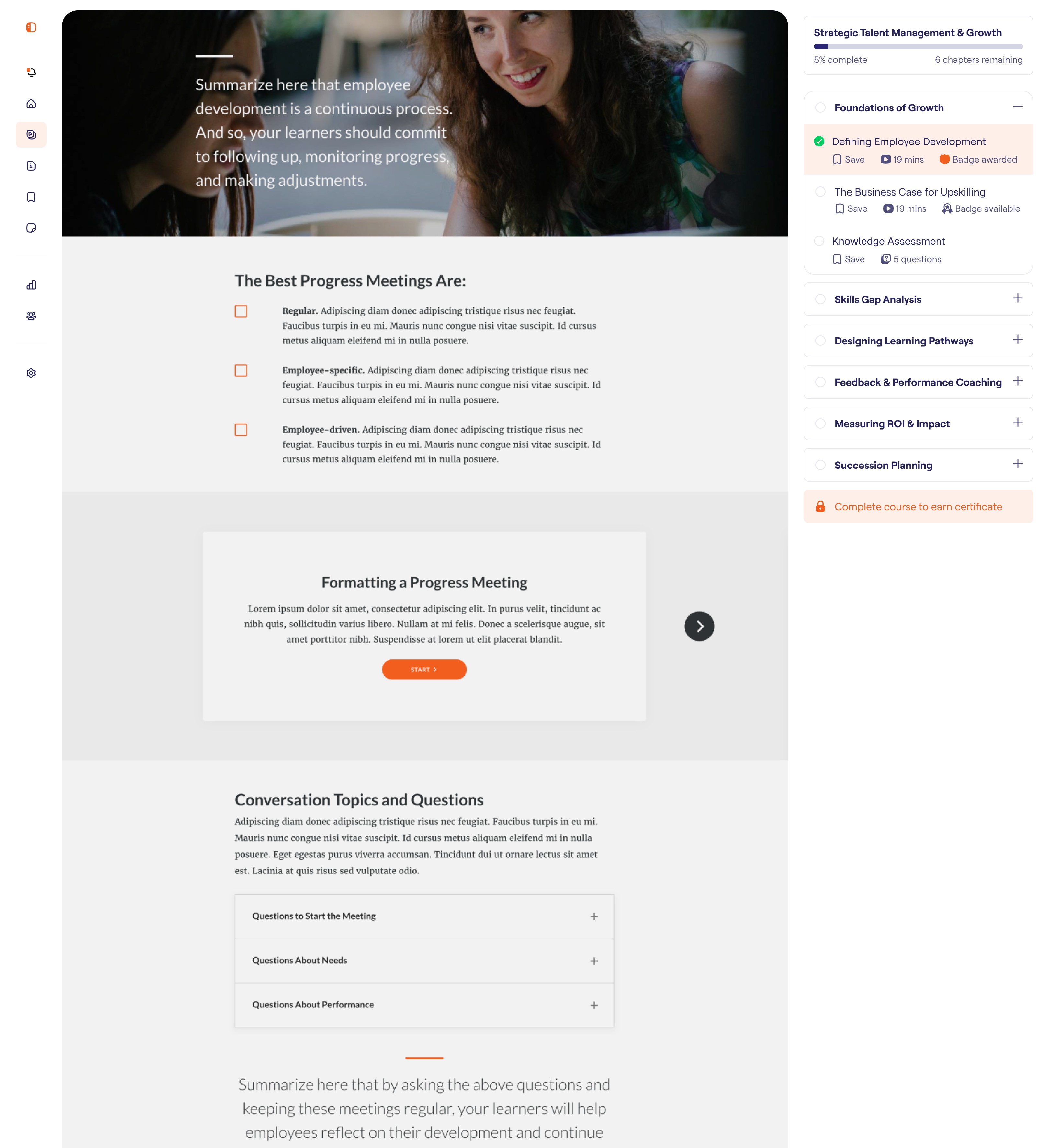
In the above example, a SCORM course built in Articulate Rise is embedded into the LMS and feels like a native part of the experience; complete with full progress tracking.
Solving the data black hole
One of the biggest risks with basic SCORM integration is data loss. In many systems, the LMS knows a user opened a SCORM file, but it doesn’t know what happened inside it. No progress data, no completion data, no quiz scores. This means the effectiveness of learning inside of a SCORM is often not measurable, and there's no real way to understand if people genuinely engage with the content.
We built full two-way communication between the SCORM file and the LMS core:
Granular Progress Tracking: We track progress inside the individual lesson. If a user leaves halfway through, the system remembers exactly where they left off. Users no longer have to scroll and sclick around trying to find their place.
Automated Completion: In many platforms, users finish a module and then have to manually click a "Mark Complete" button in the LMS. If they forget, their progress stalls. We automated this. When the SCORM file reports completion, the LMS updates instantly.
Score Synchronization: We extract and report on actual quiz scores from the file, ensuring you have a clear view of learner comprehension alongside their progress.
Unified Reporting: SCORM data feeds into the main analytics dashboard alongside native course data; no lost data and no need for multiple reporting systems.
Why growing ed-tech companies love our SCORM approach
This infrastructure solves two major logistical problems for growing ed-tech companies:
Migration is faster. Moving to a new LMS usually involves manually copying text and re-uploading videos. With this architecture, clients can simply dump existing SCORM libraries into the new system.
Hybrid course building. You don’t have to choose between a native builder and external tools. We built the logic to support hybrid structures—a course can be 90% native video lessons and 10% interactive SCORM modules.