The LMS you have vs. the one you imagined: Why your LMS deserves better

Words by
Kaine Shutler
TL;DR
Key takeaways
" transform="translate(2 2)" width="20px"/></svg>)
Blueprint before build, always: Plume Studio believes that most LMS rebuilds fail because they start with demos and features rather than aligning stakeholders on SMART outcomes.
Training & Learning Management Systems (LMS): Built Right The First Time
“We’ve worked with three other companies to build our LMS, and this is the first one that truly understands our needs and demonstrates real competence.” -TrafficSchoolOnline.com
When we hear clients say, ‘This LMS is more than I dreamed of,’ it’s not because we’ve added gimmicks. It’s because, for once, the system behaves the way they thought it would.
Most teams didn’t set out to have a clunky LMS.
They imagined something clean, flexible, and quietly reliable.
What they got instead was a legacy system, a tangle of plugins, or an “all-in-one” platform that never quite fits.
Why it matters: Your LMS is often the least-loved system in your stack, but it touches customers, partners, and employees at their most critical learning moments.
An EdTech platform aimed to provide students with university course previews, offering a glimpse into potential degree programs.
Two kinds of people who call Plume
#1: The executive or founder with a legacy LMS problem: You’re accountable for growth, revenue, or training outcomes. You might be a CEO, founder, or senior leader at a training provider or learning-focused business.
Your world looks like this:
You’re stuck between “live with the legacy LMS” and “risk another rebuild.”
You’ve already spent time and budget on platforms that didn’t quite land.
You’re overwhelmed by vendors, buzzwords, and “AI-first” promises that don’t address your actual workflows.
No SMART goals. Projects start with “better experience” instead of clear success metrics.
Quietly, you’re worried that one more failed project will look like a wasted investment.
You don’t want just a demo: You want a specialist team you can trust with a clear plan, clear outcomes, and a platform you’re not embarrassed to show to your learners, clients, or the board.
#2: The product leader or developer who owns the architecture: You might be a CPO, Head of Product, or senior engineer. You live in backlogs, roadmaps, and code reviews.
Your world looks like this:
You’re juggling core product work and a legacy LMS codebase you never chose.
Every change in the LMS feels risky because the architecture is unclear or fragile.
You know exactly how you’d fix it: Yes, but… you don’t have the engineering cycles.
The idea of bringing in a vendor sounds like more work: more meetings, more reviews, more tech debt to own.
No SMART goals. Projects start with “better experience” instead of clear success metrics.
Vendors oversell: You’re pitched features; they rarely coach you through trade-offs, scope, and realistic timelines.
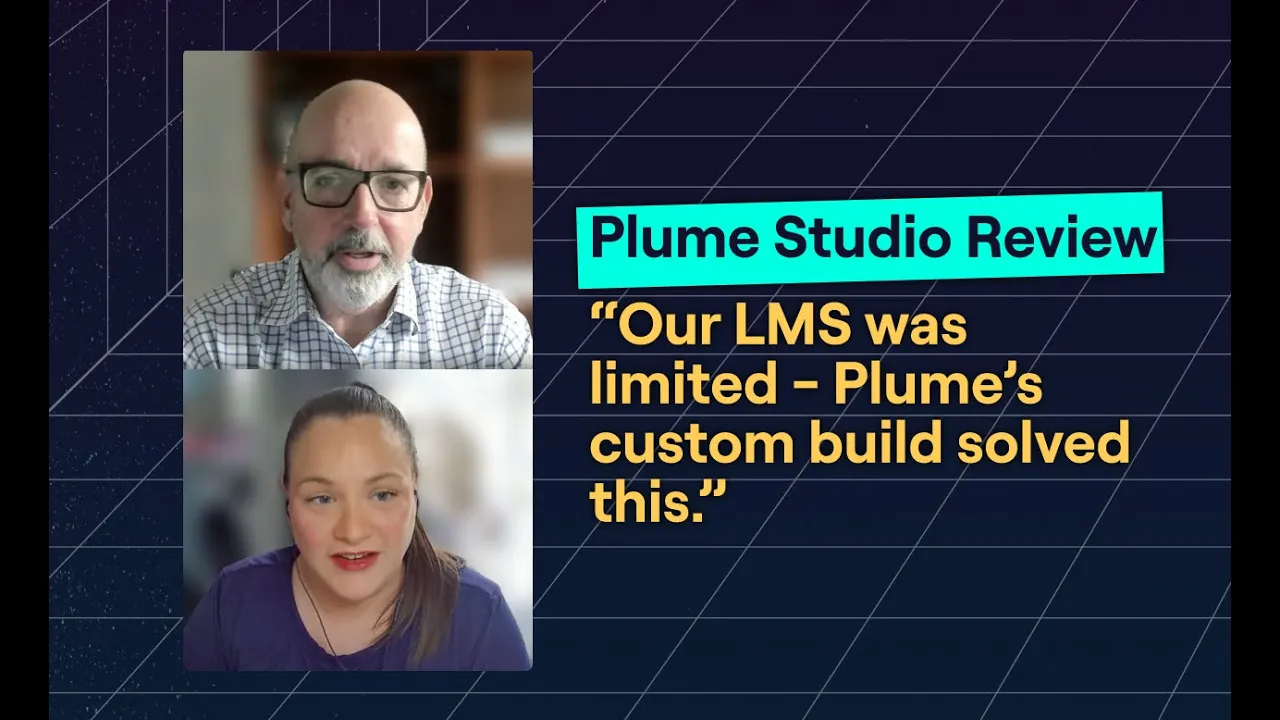
Video review from LessonFlix that said, "We wanted something more bespoke," and how it became, "it was worth it."
The Plume Blueprint-led Approach: What “more than I dreamed of” really means
Most LMS projects disappoint because they start with features and demos.
The Plume blueprint-led approach starts with outcomes and ownership: what has to change for your business, your learners, and your codebase for this to be “more than we dreamed.”
“The LMS is more than we dreamed of. Without the Plume blueprint, I think the project would have been littered with scope creep. We had a path for everyone to be on the same page, with realistic goals to reach, and prioritized which features were must-haves. ” Nick Shippers, cofounder, BioBuddy
Blueprint first, then build
We start with a structured blueprint phase:
Clarify your SMART goals, ideal customer and learner journeys, and business goals.
We focus on outcomes up front (activation, completion, NPS, revenue impact).
Map current systems and constraints.
Prioritize features using MoSCoW and define what “success” actually looks like.
And Always: Prioritize features that will move those numbers in the next 3–12 months—not just look good in a demo.
We ask:
Does this platform help us win and retain learners/customers?
Does it simplify how we deliver training rather than multiplying tools and workarounds?
Can I explain the ROI without needing a deck?
Will this make us faster six months from now, or slower?
And Always: Prioritize features that will move those numbers in the next 3–12 months—not just look good in a demo.
Start a conversation: Do you want a blueprint-style review of your current LMS?
Tell us about your LMS here, and we'll book a quick 20-min call to see if we're a good fit for you.
Kaine Shutler is the founder and managing director of Plume, a studio specialising in custom learning technology. With 14 years of experience, Kaine has established expertise in Learning Management Systems, UI/UX design, and scalability, working with clients including Google and training businesses across multiple sectors.



The LMS you have vs. the one you imagined: Why your LMS deserves better
Words by
Kaine Shutler
TL;DR
Key takeaways
Blueprint before build, always: Plume Studio believes that most LMS rebuilds fail because they start with demos and features rather than aligning stakeholders on SMART outcomes.
Training & Learning Management Systems (LMS): Built Right The First Time
“We’ve worked with three other companies to build our LMS, and this is the first one that truly understands our needs and demonstrates real competence.” -TrafficSchoolOnline.com
When we hear clients say, ‘This LMS is more than I dreamed of,’ it’s not because we’ve added gimmicks. It’s because, for once, the system behaves the way they thought it would.
Most teams didn’t set out to have a clunky LMS.
They imagined something clean, flexible, and quietly reliable.
What they got instead was a legacy system, a tangle of plugins, or an “all-in-one” platform that never quite fits.
Why it matters: Your LMS is often the least-loved system in your stack, but it touches customers, partners, and employees at their most critical learning moments.
An EdTech platform aimed to provide students with university course previews, offering a glimpse into potential degree programs.
Two kinds of people who call Plume
#1: The executive or founder with a legacy LMS problem: You’re accountable for growth, revenue, or training outcomes. You might be a CEO, founder, or senior leader at a training provider or learning-focused business.
Your world looks like this:
You’re stuck between “live with the legacy LMS” and “risk another rebuild.”
You’ve already spent time and budget on platforms that didn’t quite land.
You’re overwhelmed by vendors, buzzwords, and “AI-first” promises that don’t address your actual workflows.
No SMART goals. Projects start with “better experience” instead of clear success metrics.
Quietly, you’re worried that one more failed project will look like a wasted investment.
You don’t want just a demo: You want a specialist team you can trust with a clear plan, clear outcomes, and a platform you’re not embarrassed to show to your learners, clients, or the board.
#2: The product leader or developer who owns the architecture: You might be a CPO, Head of Product, or senior engineer. You live in backlogs, roadmaps, and code reviews.
Your world looks like this:
You’re juggling core product work and a legacy LMS codebase you never chose.
Every change in the LMS feels risky because the architecture is unclear or fragile.
You know exactly how you’d fix it: Yes, but… you don’t have the engineering cycles.
The idea of bringing in a vendor sounds like more work: more meetings, more reviews, more tech debt to own.
No SMART goals. Projects start with “better experience” instead of clear success metrics.
Vendors oversell: You’re pitched features; they rarely coach you through trade-offs, scope, and realistic timelines.
Video review from LessonFlix that said, "We wanted something more bespoke," and how it became, "it was worth it."
The Plume Blueprint-led Approach: What “more than I dreamed of” really means
Most LMS projects disappoint because they start with features and demos.
The Plume blueprint-led approach starts with outcomes and ownership: what has to change for your business, your learners, and your codebase for this to be “more than we dreamed.”
“The LMS is more than we dreamed of. Without the Plume blueprint, I think the project would have been littered with scope creep. We had a path for everyone to be on the same page, with realistic goals to reach, and prioritized which features were must-haves. ” Nick Shippers, cofounder, BioBuddy
Blueprint first, then build
We start with a structured blueprint phase:
Clarify your SMART goals, ideal customer and learner journeys, and business goals.
We focus on outcomes up front (activation, completion, NPS, revenue impact).
Map current systems and constraints.
Prioritize features using MoSCoW and define what “success” actually looks like.
And Always: Prioritize features that will move those numbers in the next 3–12 months—not just look good in a demo.
We ask:
Does this platform help us win and retain learners/customers?
Does it simplify how we deliver training rather than multiplying tools and workarounds?
Can I explain the ROI without needing a deck?
Will this make us faster six months from now, or slower?
And Always: Prioritize features that will move those numbers in the next 3–12 months—not just look good in a demo.
Start a conversation: Do you want a blueprint-style review of your current LMS?
Tell us about your LMS here, and we'll book a quick 20-min call to see if we're a good fit for you.
Kaine Shutler is the founder and managing director of Plume, a UK-based agency specialising in custom learning technology. With 14 years of experience, Kaine has established expertise in Learning Management Systems, UI/UX design, and scalability, working with clients including Google and training businesses across multiple sectors.
The LMS you have vs. the one you imagined: Why your LMS deserves better
Words by
Kaine Shutler
TL;DR
Key takeaways
Blueprint before build, always: Plume Studio believes that most LMS rebuilds fail because they start with demos and features rather than aligning stakeholders on SMART outcomes.
Training & Learning Management Systems (LMS): Built Right The First Time
“We’ve worked with three other companies to build our LMS, and this is the first one that truly understands our needs and demonstrates real competence.” -TrafficSchoolOnline.com
When we hear clients say, ‘This LMS is more than I dreamed of,’ it’s not because we’ve added gimmicks. It’s because, for once, the system behaves the way they thought it would.
Most teams didn’t set out to have a clunky LMS.
They imagined something clean, flexible, and quietly reliable.
What they got instead was a legacy system, a tangle of plugins, or an “all-in-one” platform that never quite fits.
Why it matters: Your LMS is often the least-loved system in your stack, but it touches customers, partners, and employees at their most critical learning moments.
An EdTech platform aimed to provide students with university course previews, offering a glimpse into potential degree programs.
Two kinds of people who call Plume
#1: The executive or founder with a legacy LMS problem: You’re accountable for growth, revenue, or training outcomes. You might be a CEO, founder, or senior leader at a training provider or learning-focused business.
Your world looks like this:
You’re stuck between “live with the legacy LMS” and “risk another rebuild.”
You’ve already spent time and budget on platforms that didn’t quite land.
You’re overwhelmed by vendors, buzzwords, and “AI-first” promises that don’t address your actual workflows.
No SMART goals. Projects start with “better experience” instead of clear success metrics.
Quietly, you’re worried that one more failed project will look like a wasted investment.
You don’t want just a demo: You want a specialist team you can trust with a clear plan, clear outcomes, and a platform you’re not embarrassed to show to your learners, clients, or the board.
#2: The product leader or developer who owns the architecture: You might be a CPO, Head of Product, or senior engineer. You live in backlogs, roadmaps, and code reviews.
Your world looks like this:
You’re juggling core product work and a legacy LMS codebase you never chose.
Every change in the LMS feels risky because the architecture is unclear or fragile.
You know exactly how you’d fix it: Yes, but… you don’t have the engineering cycles.
The idea of bringing in a vendor sounds like more work: more meetings, more reviews, more tech debt to own.
No SMART goals. Projects start with “better experience” instead of clear success metrics.
Vendors oversell: You’re pitched features; they rarely coach you through trade-offs, scope, and realistic timelines.
Video review from LessonFlix that said, "We wanted something more bespoke," and how it became, "it was worth it."
The Plume Blueprint-led Approach: What “more than I dreamed of” really means
Most LMS projects disappoint because they start with features and demos.
The Plume blueprint-led approach starts with outcomes and ownership: what has to change for your business, your learners, and your codebase for this to be “more than we dreamed.”
“The LMS is more than we dreamed of. Without the Plume blueprint, I think the project would have been littered with scope creep. We had a path for everyone to be on the same page, with realistic goals to reach, and prioritized which features were must-haves. ” Nick Shippers, cofounder, BioBuddy
Blueprint first, then build
We start with a structured blueprint phase:
Clarify your SMART goals, ideal customer and learner journeys, and business goals.
We focus on outcomes up front (activation, completion, NPS, revenue impact).
Map current systems and constraints.
Prioritize features using MoSCoW and define what “success” actually looks like.
And Always: Prioritize features that will move those numbers in the next 3–12 months—not just look good in a demo.
We ask:
Does this platform help us win and retain learners/customers?
Does it simplify how we deliver training rather than multiplying tools and workarounds?
Can I explain the ROI without needing a deck?
Will this make us faster six months from now, or slower?
And Always: Prioritize features that will move those numbers in the next 3–12 months—not just look good in a demo.
Start a conversation: Do you want a blueprint-style review of your current LMS?
Tell us about your LMS here, and we'll book a quick 20-min call to see if we're a good fit for you.
Kaine Shutler is the founder and managing director of Plume, a UK-based agency specialising in custom learning technology. With 14 years of experience, Kaine has established expertise in Learning Management Systems, UI/UX design, and scalability, working with clients including Google and training businesses across multiple sectors.
Plan your next learning platform with our founder
About Plume
As the leading custom learning platform provider serving training businesses in the US, UK and Europe, we help businesses design, build and grow pioneering learning tech that unlocks limitless growth potential.

Plan your next learning platform with our founder
About Plume
As the leading custom learning platform provider serving training businesses in the US, UK and Europe, we help businesses design, build and grow pioneering learning tech that unlocks limitless growth potential.
Plan your next learning platform with our founder
About Plume
As the leading custom learning platform provider serving training businesses in the US, UK and Europe, we help businesses design, build and grow pioneering learning tech that unlocks limitless growth potential.
