Why Your iPhone Might Be Better Than a Studio for Training Videos

Words by
Kaine Shutler
TL;DR
Key takeaways
" transform="translate(2 2)" width="20px"/></svg>)
Production quality doesn't equal learning outcomes – Multiple studies show students perform equally well on assessments whether they watch high-budget studio videos or basic instructor-recorded content.
Authenticity builds more trust than polish – Learners often prefer content from their actual instructor over slick third-party productions because it creates genuine social presence and credibility.
Invest in instructional design, not cinematography – What matters is video length (6 minutes optimal), interactivity, clear audio, and accessibility – not lighting, transitions, or 4K resolution.
Three reasons why throwing money at video production won't fix your training outcomes
We've built over 200 learning platforms in the last decade. And we keep seeing the same pattern: expensive training videos don't work better than cheaper ones.
A client recently upgraded one of their cornerstone courses. They kept the same content and instructional design, but replaced the DIY videos with professional production. Studio shoots, professional crew, full post-production. Investment: £25,000.
Six months later, they compared the metrics: completion rates, assessment scores, time-to-competency. Professional version vs. the old phone-filmed videos.
No difference.
This pattern shows up constantly across our 200+ platform builds. When instructional design is sound, production quality doesn't move the needle on learning outcomes.
Let me explain why.
1. Your brain doesn't care about your cinematographer
Multiple studies have found what researchers call the "No Significant Difference Phenomenon" – students watching professionally produced videos perform no better on assessments than those watching basic instructor-recorded content.
The reason comes down to cognitive load. Your brain processes information through two channels: visual and auditory. Each channel has finite capacity. When you overload either channel with unnecessary information, learning actually decreases.
That cinematic background music is cognitive load. Those sleek transition effects are more cognitive load. The B-roll footage of your office? You're asking learners' brains to process decorative information instead of the actual content they need.
Richard Mayer's Coherence Principle is clear on this: learning improves when you exclude unnecessary words, sounds, and visuals. Not when you add more of them.
2. Authenticity beats polish (most of the time)
We've seen this in user research across dozens of projects: learners often prefer content created by their actual instructor over slick third-party productions.
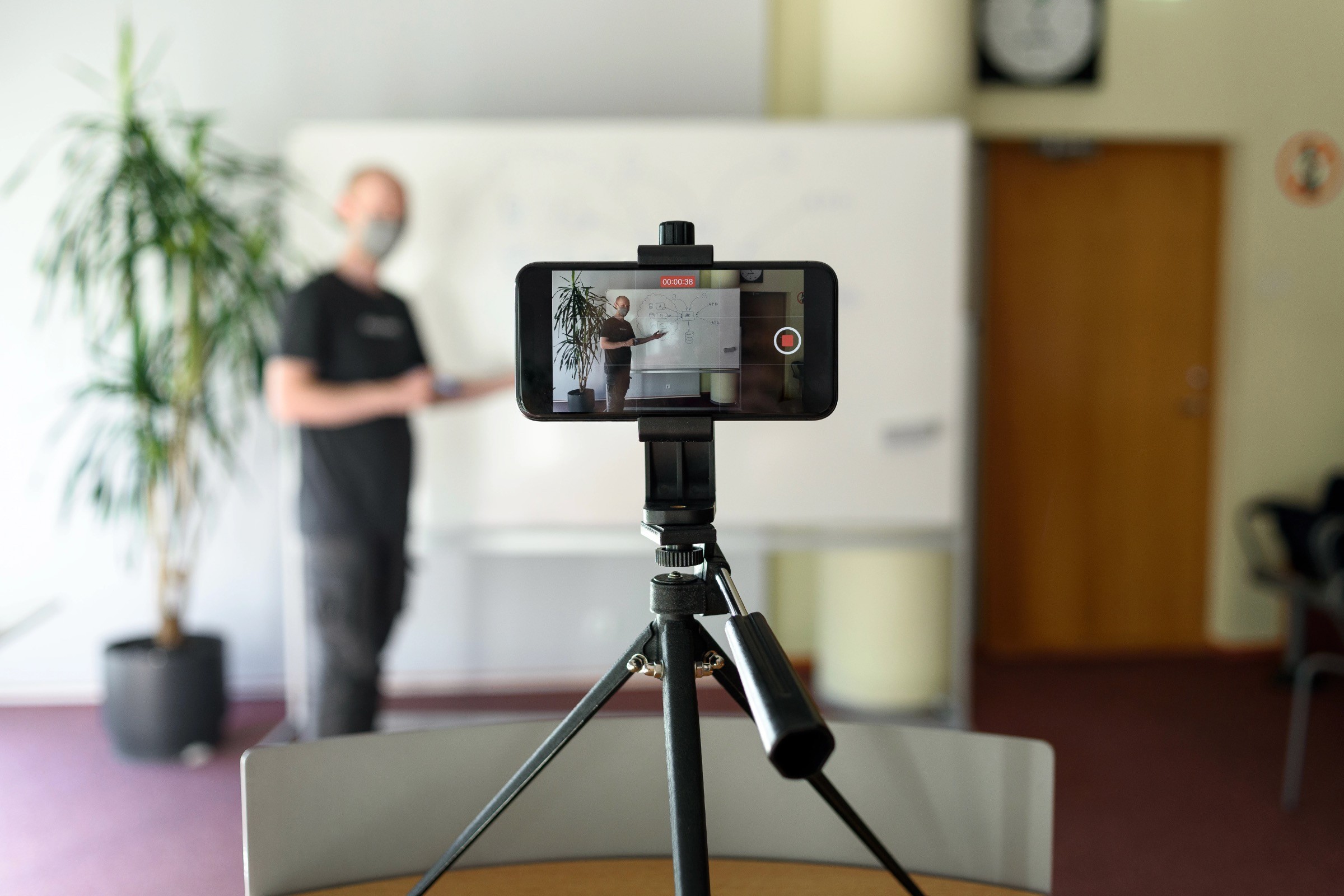
It's about social presence – the feeling that you're learning from a real person who knows what they're talking about. An expert filming themselves in their office, complete with the occasional stumble or natural pause, can create more trust and connection than a polished presenter reading a script in a studio.
Think about it: when you want to learn how to fix something, where do you go? YouTube. And what do you find? Subject matter experts filming themselves on their phones, often with questionable lighting and background noise.
It works because authenticity signals expertise in a way that production value can't.
3. You're solving the wrong problem
Most organisations throw money at video production when they should be investing in instructional design.
What's the difference? Production is about how it looks. Instructional design is about how it works.
Here's what actually improves learning outcomes:
Video length: Peak engagement happens around 6 minutes. After that, attention drops off significantly.
Interactivity: Embedding questions throughout the video leads to significantly better retention than passive watching.
Audio quality: This is the one production element that actually matters. Poor audio increases cognitive load and makes content unwatchable.
Accessibility: Captions, transcripts, and proper contrast matter far more than 4K resolution.
You can have all of these in a DIY iPhone video. You can also have none of them in an £85,000 studio production.
So when should you invest in professional production?
I'm not saying professional production has no place. It does. But you need to be strategic about where you use it.
Use professional production for:
High-stakes brand content where credibility is paramount
Content with a long shelf life that will be viewed by thousands
Complex topics requiring sophisticated animations or simulations
Stick with DIY for:
Frequent updates or rapidly changing content
Subject matter expert explanations where authenticity builds trust
Internal training where your team values substance over style
The real sweet spot
Here's what we recommend to our clients: invest in a mid-tier approach that prioritises instructional design over cinematography.
This means:
A decent microphone (£100-300)
Basic lighting setup (natural light or a ring light works)
Clear, tested scripts focused on learning objectives
Strategic interactivity built into your LMS
Professional editing for pacing and clarity (not flash)
This typically costs £400-2,000 per minute of final content. It's enough to look credible without wasting budget on diminishing returns.
The bottom line
Production quality is a threshold issue, not a linear one. You need to clear a basic bar of technical competence – clear audio, stable video, coherent structure. Beyond that, more polish doesn't equal better learning.
What actually matters is whether your content is:
Focused on clear learning objectives
Chunked into digestible segments
Delivered by credible experts
Supported by interactivity and practice
Accessible to all learners
Your iPhone can do all of that. Your £85,000 studio shoot can't guarantee any of it.
So before you book that production company, ask yourself: are you trying to impress people, or are you trying to help them learn?
Because if it's the latter, your learners won't care about your three-point lighting.
Kaine Shutler is the founder and managing director of Plume, a studio specialising in custom learning technology. With 14 years of experience, Kaine has established expertise in Learning Management Systems, UI/UX design, and scalability, working with clients including Google and training businesses across multiple sectors.

Why Your iPhone Might Be Better Than a Studio for Training Videos
Words by
Kaine Shutler
TL;DR
Key takeaways
Production quality doesn't equal learning outcomes – Multiple studies show students perform equally well on assessments whether they watch high-budget studio videos or basic instructor-recorded content.
Authenticity builds more trust than polish – Learners often prefer content from their actual instructor over slick third-party productions because it creates genuine social presence and credibility.
Invest in instructional design, not cinematography – What matters is video length (6 minutes optimal), interactivity, clear audio, and accessibility – not lighting, transitions, or 4K resolution.
Three reasons why throwing money at video production won't fix your training outcomes
We've built over 200 learning platforms in the last decade. And we keep seeing the same pattern: expensive training videos don't work better than cheaper ones.
A client recently upgraded one of their cornerstone courses. They kept the same content and instructional design, but replaced the DIY videos with professional production. Studio shoots, professional crew, full post-production. Investment: £25,000.
Six months later, they compared the metrics: completion rates, assessment scores, time-to-competency. Professional version vs. the old phone-filmed videos.
No difference.
This pattern shows up constantly across our 200+ platform builds. When instructional design is sound, production quality doesn't move the needle on learning outcomes.
Let me explain why.
1. Your brain doesn't care about your cinematographer
Multiple studies have found what researchers call the "No Significant Difference Phenomenon" – students watching professionally produced videos perform no better on assessments than those watching basic instructor-recorded content.
The reason comes down to cognitive load. Your brain processes information through two channels: visual and auditory. Each channel has finite capacity. When you overload either channel with unnecessary information, learning actually decreases.
That cinematic background music is cognitive load. Those sleek transition effects are more cognitive load. The B-roll footage of your office? You're asking learners' brains to process decorative information instead of the actual content they need.
Richard Mayer's Coherence Principle is clear on this: learning improves when you exclude unnecessary words, sounds, and visuals. Not when you add more of them.
2. Authenticity beats polish (most of the time)
We've seen this in user research across dozens of projects: learners often prefer content created by their actual instructor over slick third-party productions.
It's about social presence – the feeling that you're learning from a real person who knows what they're talking about. An expert filming themselves in their office, complete with the occasional stumble or natural pause, can create more trust and connection than a polished presenter reading a script in a studio.
Think about it: when you want to learn how to fix something, where do you go? YouTube. And what do you find? Subject matter experts filming themselves on their phones, often with questionable lighting and background noise.
It works because authenticity signals expertise in a way that production value can't.
3. You're solving the wrong problem
Most organisations throw money at video production when they should be investing in instructional design.
What's the difference? Production is about how it looks. Instructional design is about how it works.
Here's what actually improves learning outcomes:
Video length: Peak engagement happens around 6 minutes. After that, attention drops off significantly.
Interactivity: Embedding questions throughout the video leads to significantly better retention than passive watching.
Audio quality: This is the one production element that actually matters. Poor audio increases cognitive load and makes content unwatchable.
Accessibility: Captions, transcripts, and proper contrast matter far more than 4K resolution.
You can have all of these in a DIY iPhone video. You can also have none of them in an £85,000 studio production.
So when should you invest in professional production?
I'm not saying professional production has no place. It does. But you need to be strategic about where you use it.
Use professional production for:
High-stakes brand content where credibility is paramount
Content with a long shelf life that will be viewed by thousands
Complex topics requiring sophisticated animations or simulations
Stick with DIY for:
Frequent updates or rapidly changing content
Subject matter expert explanations where authenticity builds trust
Internal training where your team values substance over style
The real sweet spot
Here's what we recommend to our clients: invest in a mid-tier approach that prioritises instructional design over cinematography.
This means:
A decent microphone (£100-300)
Basic lighting setup (natural light or a ring light works)
Clear, tested scripts focused on learning objectives
Strategic interactivity built into your LMS
Professional editing for pacing and clarity (not flash)
This typically costs £400-2,000 per minute of final content. It's enough to look credible without wasting budget on diminishing returns.
The bottom line
Production quality is a threshold issue, not a linear one. You need to clear a basic bar of technical competence – clear audio, stable video, coherent structure. Beyond that, more polish doesn't equal better learning.
What actually matters is whether your content is:
Focused on clear learning objectives
Chunked into digestible segments
Delivered by credible experts
Supported by interactivity and practice
Accessible to all learners
Your iPhone can do all of that. Your £85,000 studio shoot can't guarantee any of it.
So before you book that production company, ask yourself: are you trying to impress people, or are you trying to help them learn?
Because if it's the latter, your learners won't care about your three-point lighting.
Kaine Shutler is the founder and managing director of Plume, a UK-based agency specialising in custom learning technology. With 14 years of experience, Kaine has established expertise in Learning Management Systems, UI/UX design, and scalability, working with clients including Google and training businesses across multiple sectors.
Why Your iPhone Might Be Better Than a Studio for Training Videos
Words by
Kaine Shutler
TL;DR
Key takeaways
Production quality doesn't equal learning outcomes – Multiple studies show students perform equally well on assessments whether they watch high-budget studio videos or basic instructor-recorded content.
Authenticity builds more trust than polish – Learners often prefer content from their actual instructor over slick third-party productions because it creates genuine social presence and credibility.
Invest in instructional design, not cinematography – What matters is video length (6 minutes optimal), interactivity, clear audio, and accessibility – not lighting, transitions, or 4K resolution.
Three reasons why throwing money at video production won't fix your training outcomes
We've built over 200 learning platforms in the last decade. And we keep seeing the same pattern: expensive training videos don't work better than cheaper ones.
A client recently upgraded one of their cornerstone courses. They kept the same content and instructional design, but replaced the DIY videos with professional production. Studio shoots, professional crew, full post-production. Investment: £25,000.
Six months later, they compared the metrics: completion rates, assessment scores, time-to-competency. Professional version vs. the old phone-filmed videos.
No difference.
This pattern shows up constantly across our 200+ platform builds. When instructional design is sound, production quality doesn't move the needle on learning outcomes.
Let me explain why.
1. Your brain doesn't care about your cinematographer
Multiple studies have found what researchers call the "No Significant Difference Phenomenon" – students watching professionally produced videos perform no better on assessments than those watching basic instructor-recorded content.
The reason comes down to cognitive load. Your brain processes information through two channels: visual and auditory. Each channel has finite capacity. When you overload either channel with unnecessary information, learning actually decreases.
That cinematic background music is cognitive load. Those sleek transition effects are more cognitive load. The B-roll footage of your office? You're asking learners' brains to process decorative information instead of the actual content they need.
Richard Mayer's Coherence Principle is clear on this: learning improves when you exclude unnecessary words, sounds, and visuals. Not when you add more of them.
2. Authenticity beats polish (most of the time)
We've seen this in user research across dozens of projects: learners often prefer content created by their actual instructor over slick third-party productions.
It's about social presence – the feeling that you're learning from a real person who knows what they're talking about. An expert filming themselves in their office, complete with the occasional stumble or natural pause, can create more trust and connection than a polished presenter reading a script in a studio.
Think about it: when you want to learn how to fix something, where do you go? YouTube. And what do you find? Subject matter experts filming themselves on their phones, often with questionable lighting and background noise.
It works because authenticity signals expertise in a way that production value can't.
3. You're solving the wrong problem
Most organisations throw money at video production when they should be investing in instructional design.
What's the difference? Production is about how it looks. Instructional design is about how it works.
Here's what actually improves learning outcomes:
Video length: Peak engagement happens around 6 minutes. After that, attention drops off significantly.
Interactivity: Embedding questions throughout the video leads to significantly better retention than passive watching.
Audio quality: This is the one production element that actually matters. Poor audio increases cognitive load and makes content unwatchable.
Accessibility: Captions, transcripts, and proper contrast matter far more than 4K resolution.
You can have all of these in a DIY iPhone video. You can also have none of them in an £85,000 studio production.
So when should you invest in professional production?
I'm not saying professional production has no place. It does. But you need to be strategic about where you use it.
Use professional production for:
High-stakes brand content where credibility is paramount
Content with a long shelf life that will be viewed by thousands
Complex topics requiring sophisticated animations or simulations
Stick with DIY for:
Frequent updates or rapidly changing content
Subject matter expert explanations where authenticity builds trust
Internal training where your team values substance over style
The real sweet spot
Here's what we recommend to our clients: invest in a mid-tier approach that prioritises instructional design over cinematography.
This means:
A decent microphone (£100-300)
Basic lighting setup (natural light or a ring light works)
Clear, tested scripts focused on learning objectives
Strategic interactivity built into your LMS
Professional editing for pacing and clarity (not flash)
This typically costs £400-2,000 per minute of final content. It's enough to look credible without wasting budget on diminishing returns.
The bottom line
Production quality is a threshold issue, not a linear one. You need to clear a basic bar of technical competence – clear audio, stable video, coherent structure. Beyond that, more polish doesn't equal better learning.
What actually matters is whether your content is:
Focused on clear learning objectives
Chunked into digestible segments
Delivered by credible experts
Supported by interactivity and practice
Accessible to all learners
Your iPhone can do all of that. Your £85,000 studio shoot can't guarantee any of it.
So before you book that production company, ask yourself: are you trying to impress people, or are you trying to help them learn?
Because if it's the latter, your learners won't care about your three-point lighting.
Kaine Shutler is the founder and managing director of Plume, a UK-based agency specialising in custom learning technology. With 14 years of experience, Kaine has established expertise in Learning Management Systems, UI/UX design, and scalability, working with clients including Google and training businesses across multiple sectors.
Plan your next learning platform with our founder
About Plume
As the leading custom learning platform provider serving training businesses in the US, UK and Europe, we help businesses design, build and grow pioneering learning tech that unlocks limitless growth potential.
Plan your next learning platform with our founder
About Plume
As the leading custom learning platform provider serving training businesses in the US, UK and Europe, we help businesses design, build and grow pioneering learning tech that unlocks limitless growth potential.
Plan your next learning platform with our founder
About Plume
As the leading custom learning platform provider serving training businesses in the US, UK and Europe, we help businesses design, build and grow pioneering learning tech that unlocks limitless growth potential.
